Sold
Under sale
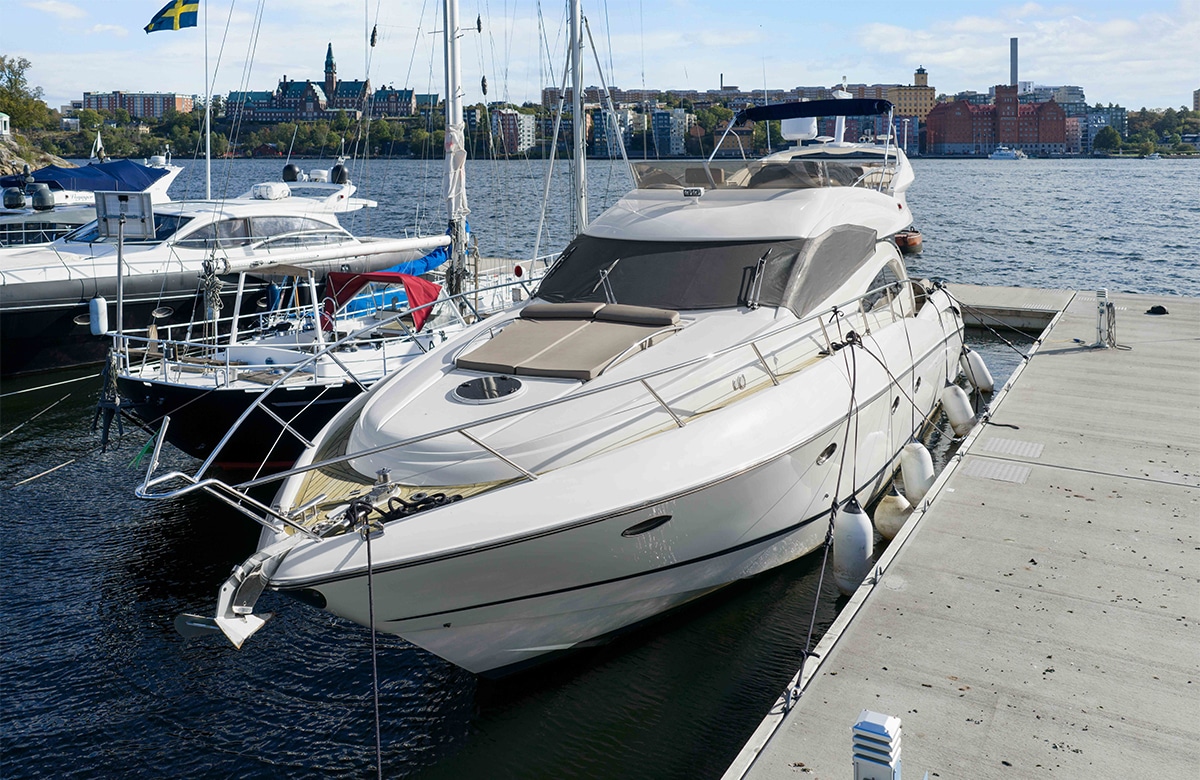
Sunseeker Manhattan 56
Built year: 2000


Selling a boat through Navark involves eight steps, from valuation to payment. We call it Navark’s proven sales process, refined over more than 35 years and thousands of boat transactions.
1. Valuation and asking price. We assess the boat’s model, condition and equipment against actual selling prices for comparable boats and current listings. You, as the owner, always decide the asking price.
2. Brokerage agreement. Before work begins, we sign an agreement setting out the assignment, its duration and our fee.
3. Preparation and documentation. We review the equipment list, ownership history and accompanying documents. Known defects are recorded in a defect list to fulfil the seller’s duty of disclosure.
4. Photography and video. We photograph and film the boat at your location, using a professional photographer for premium listings.
5. Marketing. We advertise on navark.se and more than 40 international boat websites, post on social media and send targeted mailings to our buyer database.
6. Enquiries and viewings. We handle all enquiries and conduct viewings, preferably with you present. We provide regular updates and pass on every offer.
7. Negotiation. We negotiate on your behalf and defend the market value we have established together. Any compromises are agreed with you.
8. Contract, survey and completion. We prepare a sale agreement valid for domestic and international transactions and handle payment through a segregated client account. After delivery, we transfer the purchase price to you less our commission, together with a settlement statement.
A yacht broker handles the entire sales process: valuation, presentation, marketing, enquiries, viewings, negotiation, contracts and payment. Four factors determine the value of this service.
Time. A boat sale often generates 10–50 individual enquiries. Each requires a prompt, professional response and usually further dialogue. An experienced broker also screens prospective buyers so viewings are reserved for people with both the funds and a genuine intention to buy soon.
Reach. International exposure costs money: boat websites charge to advertise in their markets. Navark advertises on more than 40 boat websites, focusing on Europe. The more potential buyers who see the boat, the better the chances of selling it, and at a stronger price.
Security. The broker ensures the transaction is handled correctly: agreements are properly drafted, sellers fulfil their disclosure obligations and buyers can exercise their duty to inspect. Navark never releases a boat until the purchase price is in our client account.
Price and presentation. A professional broker prices the boat against the international market, not just the local one, and ensures all documents pass to the new owner. This is also why brokered boats often achieve higher final prices than privately sold boats.
It varies, and there are no comprehensive statistics for Sweden’s used-boat market. For boats brokered by Navark, the median selling time is 77 days—just over two and a half months from brokerage agreement to signed sale agreement. Just over half sell within three months, and 96% within a year. Larger boats take longer: above SEK 2 million, the median rises to around six months because the buyer pool is smaller and buyers are more often based abroad.
The most important factors are pricing relative to the market, the boat’s condition and documentation, and demand for that particular model. Correctly priced boats often receive their first serious enquiries within a few weeks. Most transactions are signed between March and September.
Navark’s own brokerage transactions: 52 of 159 completed sales in 2025–2026 with complete contract dates. Measured from the brokerage agreement, i.e. before the listing is published. Updated continuously.
Five things make the biggest difference to both the price and the time it takes to sell.
Clean and declutter. Thoroughly clean the boat, including floors, lockers and engine room, and remove personal belongings before photography. If the boat is ashore, fresh antifouling is a modest investment that shows immediately in photographs.
Make sure everything can be demonstrated. The engine must start, batteries must be charged and there must be water in the tank so the pump, heater, fridge and electronics can be demonstrated. Buyers assume that anything which cannot be demonstrated is faulty.
Fix minor defects. Leaking taps, broken lights, worn fenders and canvas. Buyers generally deduct more during negotiation than the repairs would have cost.
Gather the documents. Service history, receipts for major work, proof of ownership, ownership chain, any survey report, and evidence of VAT status and Union status. Unclear VAT status can stop an international sale entirely.
Be open about defects. Navark prepares a defect list with you, disclosing known faults to fulfil the duty of disclosure. A declared defect costs less in negotiations than one discovered by the buyer’s surveyor.
You do not need everything ready before contacting us—we will work through the preparations together.
Often, but it depends on the boat. The brokerage fee must be deducted, so the relevant question is whether the sale achieves enough extra value to cover it. Three factors suggest that it can.
Reach matters most. The price is set by the buyer who values the boat most highly, and competition between more serious buyers strengthens the final price. Most boats brokered by Navark go to buyers outside Sweden, and almost half of enquiries come from abroad. Our focus is Europe—including Denmark, Germany, Finland, Norway, the Netherlands, Italy and France—but our reach is global. For the right boat, the buyer may be anywhere in the world, provided they can find the listing.
Presentation determines whether buyers stop at an advert or scroll past it. Navark photographs and films the boat on location, using a professional photographer and drone for premium listings. We put equal effort into the text: a detailed equipment list, a description highlighting the boat’s real strengths and an openly disclosed defect list. A boat presented as well maintained and documented is perceived that way, leaving less room for aggressive bargaining.
Negotiation is where a broker’s skills determine the outcome; boating knowledge alone does not make someone a skilled negotiator. Navark selects brokers for precisely this ability. Many have been managing directors or sales managers, where negotiation was central to their work. A Navark broker understands motorboats and sailing yachts—but above all is a skilled negotiator.
A broker makes the greatest difference when the buyer pool is international or specialised, and when significant sums cross borders. For a simpler boat with plenty of local buyers, the difference is smaller.
Condition matters most. How a boat has been cared for and maintained is more important than its year—a well-maintained 20-year-old boat may be worth more than a neglected boat ten years newer.
Care and condition. A polished hull, a deck in good condition, a well-serviced engine and a clean, tidy boat affect value more than many realise. Buyers pay particular attention to the deck.
Documentation. A complete service history, clear ownership history and openly disclosed defects. VAT documentation is crucial in international sales; if it is missing, as is common with older boats, Navark helps obtain it.
Equipment and installations. Modern equipment adds value, but only when professionally installed. Poor installation can reduce value even if the equipment is new. Power systems have become increasingly important, often including lithium batteries.
Model and builder. Boats from established builders retain value better because buyers seek out those brands regardless of the wider market.
Market conditions. Exchange rates, interest rates and the economy affect the entire market. In international sales, a weak Swedish krona can make Swedish boats more attractive to euro buyers.
Upgrades such as a new engine, modern electronics or new sails rarely increase value krona for krona, but they slow depreciation and make a boat easier to sell.
Our marketing has three elements: the presentation of the boat, advertising and our own buyer network.
Presentation is about more than photos and video. We photograph and film the boat on location, using a professional photographer and drone for premium listings, but the written description is equally important. We prepare detailed equipment lists and, for larger boats, a dedicated sales brochure. At Navark, we believe honesty is the best policy: we prepare a defect list with you and give buyers an accurate picture of the boat. Defects buyers discover themselves are among the most common reasons for a sale falling through or for major last-minute price reductions.
Advertising takes place on navark.se and more than 40 boat websites in Sweden and internationally, including YachtWorld, boats.com, Boat24, Scanboat, iNautia, Finn.no in Norway, Nettivene in Finland, boote.de in Germany and Todobarco in Spain. We also advertise in around ten boating newspapers and magazines, both online and in print. Advertising costs nothing extra; it is included in the brokerage fee.
Social media is a dedicated channel for us, not an afterthought. Every boat we take on gets its own post on Facebook and Instagram, and we publish videos on YouTube. Some individual posts and videos have reached hundreds of thousands of views, exposing boats even to people who are not actively browsing boat websites.
Our buyer network has taken the longest to build. Navark has an extensive database of prospects and buyers across all price ranges. During peak season, we send updates on the latest listings almost every week. We also send a dedicated newsletter to fellow brokers across Europe: if they have a buyer, we share our fee. Some boats sell this way, occasionally before the advert is even published.
The transaction has five stages: contract, survey, payment, delivery and settlement.
The sale agreement. Once the parties agree, we prepare an agreement suitable for both domestic and international transactions. Its structure has been tested in thousands of sales but is adapted to each case. For several years Navark has worked with a commercial lawyer specialising in sales and consumer law.
The survey. We always encourage buyers to commission an independent survey before taking delivery. This benefits both parties: the buyer gets an independent assessment of condition, and the seller gets a report recording the boat’s condition at handover—the final opportunity to document that it matched the description.
Payment. Funds pass through Navark’s client account, entirely separate from our own money. The buyer normally pays a deposit when signing and the balance before delivery. We check that any loans and mortgages have been discharged, verify buyer and seller identities under anti-money-laundering rules, and confirm that the seller is the lawful owner.
Delivery. Navark carries out its own delivery inspection and the buyer signs our delivery acceptance. The new owner receives the correct documentation, including a properly prepared Bill of Sale.
Settlement. After accepted delivery, we transfer the purchase price to you, less our fee, with a settlement statement.
Three things to check with any yacht broker you choose
• That the client account is genuine. Ask the broker for confirmation from their bank that it is a segregated client account. Any reputable broker can provide this on request.
• That anti-money-laundering rules are followed in practice. A broker accepting cash as part payment lacks adequate procedures. Navark always verifies both parties and accepts neither cash nor cryptocurrency.
• That the contractual framework is sound. Ask whether a lawyer has reviewed the agreements and whether the broker has handled international sales before. Costly mistakes are made in contracts and often become apparent only when something goes wrong.
Nothing can ever be guaranteed. Boats are boats, and things break. But risks can be minimised, and that is precisely why experience matters.
Navark was founded in 1990 and has over 35 years of experience and thousands of completed boat transactions. We specialise in larger, well-maintained boats with an international buyer base.
Premium boats are our everyday business. In an October 2026 market survey covering 45 Swedish and Danish brokers and their entire inventories, almost one in five boats priced above SEK 5 million was listed with Navark. The median boat in our inventory costs around SEK 1.8 million, compared with SEK 845,000 for the market as a whole. If you own a more expensive boat, you are not an exception with us.
Brokerage is all we do. Navark does not operate a boatyard or service workshop and does not sell new boats. Brokerage of used boats is our entire business. A company that also sells new boats faces pressure from builders to prioritise new sales, and used boats can take second place when buyers compare new and pre-owned options. We have no such conflict of interest.
We are international in practice. Many of the boats we broker are not in the Nordic countries at all but in the Mediterranean, Caribbean or elsewhere. Our head office is in Norra Hamnen, Helsingborg, with our own berths, and we have brokers from Umeå in the north to Malmö in the south, as well as in Denmark.
We have stood the test of time. Navark has operated through every boom and downturn since 1990 and holds the highest credit rating with both Dun & Bradstreet (AAA) and UC. Many clients return, staying with us throughout their boating lives and making all their transactions with the same broker—relationships that often grow into friendships.
But the most important thing is harder to list. Selling a boat is built on trust between you and your broker, and we must earn that trust in every transaction.